A Plate to Contain With

How to: Make a Breast(s)

Art & Illusion: A Guide to Crossdressing: Third Edition Vol. 2 (2000)

New Trenns Magazine - Vol. 1 Number 4 (1970)

Transgender Tapestry: Issue 84 (1998)

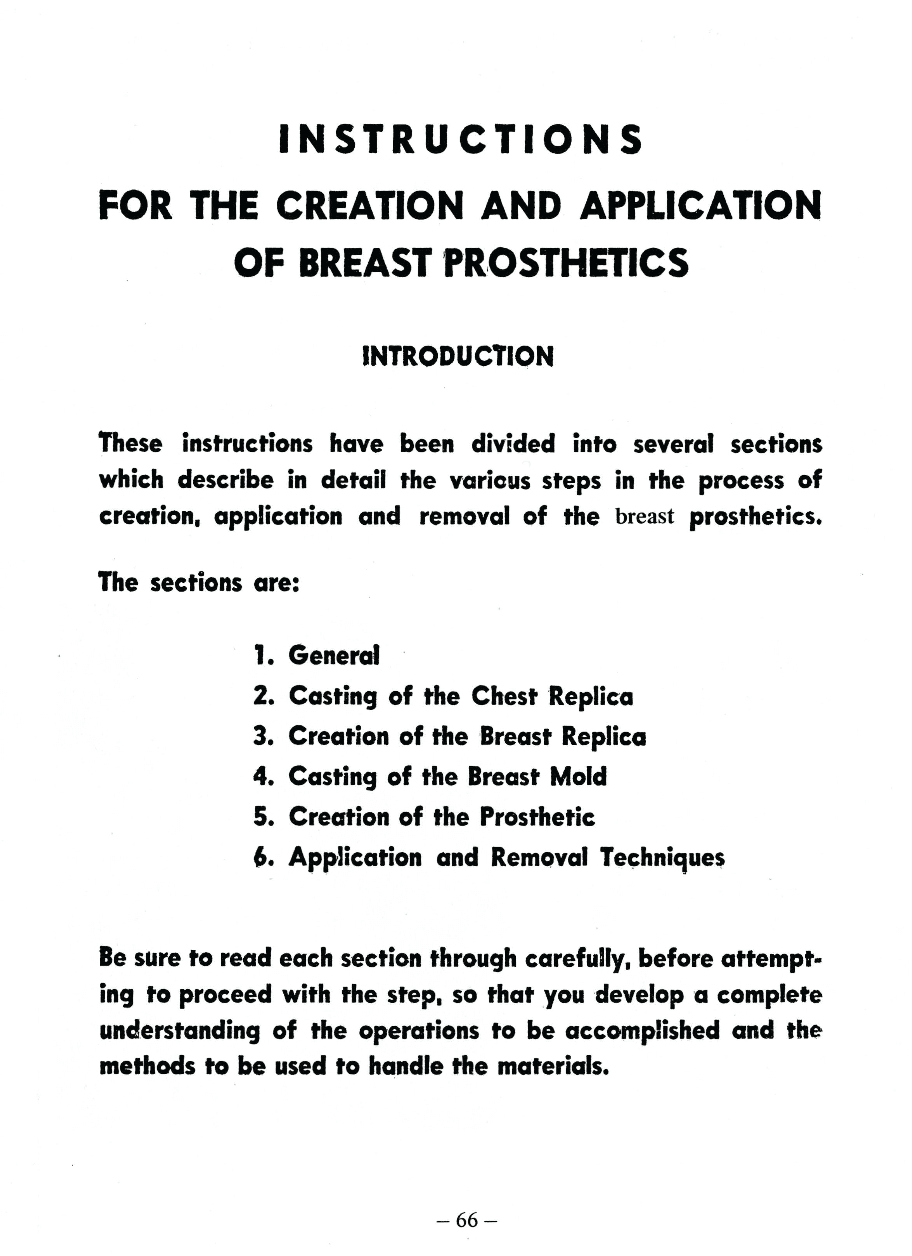
These four excerpts share about different possibilities for how breasts might be made. Made out of plates with additions, bags clipped and turned inside out, prosthetics that can be added and removed, questions about “plastic worm material” and weather or not it matters if nipples are colored.

These ads, tutorials and step-by-step instructions make various plates to contain the body - by adding to it - adding some body parts can make you feel held and visible just right. Negotiating how to be detected — or not — with silicone, water, freezer gel and plaster to make a breast plate that has the right “bounce, weight and feel” is an ongoing practice.

1. This is an excerpt from the magazine Art & Illusion: A Guide to Crossdressing Volume 2. We see here six steps to take everyday materials and turn them into breast forms. First, you nest three baggies. Then you take an eraser and put it inside each corner, with a rubber band you make a “noose” and loop it around the erasers. You turn the bags inside out so that the rubber band is inside. Then you fill the bag with water or freezer gel. From here you turn the bags over and tie the neck with fishing line or waxed dental floss: to close it and make the nipple. Then, you repeat - to get two. 
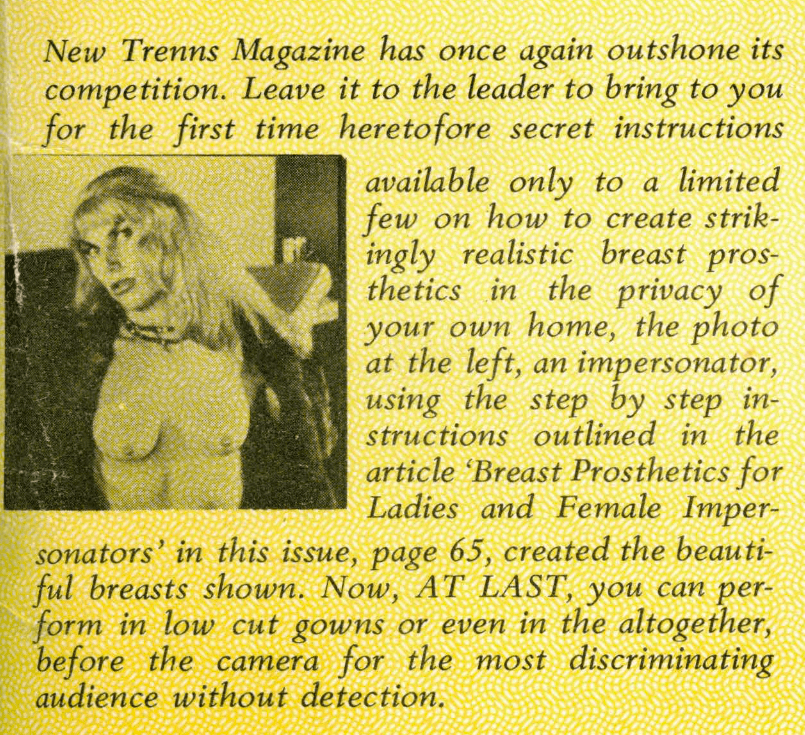
2. This is an add from the magazine New Trenns Magazine. The add begins with the claim “New Trenns Magazine has once again outshone its competition.” On the left of the add is someone wearing a breast prosthetic plate. On the right is text advertising that on page 65, AT LAST you can now perform with realistic breasts: passing. 
3. This is an add selling Breast Forms for $79.95 per pair (for sizes between 8 - 16) from the magazine Transgender Tapestry. In the text of the add they state “They don’t “glue on”, the nipple isn’t colored, but they have the right weight, bounce and feel.”
4. This is an introduction and instructions “For the Creation and Application of Breast Prosthetics” from the New Trenns Magazine. In six steps it tells of how to start cast, create, make a prosthetic and take on and off your new breast plate prosthetic.”. 

Compression Shirts

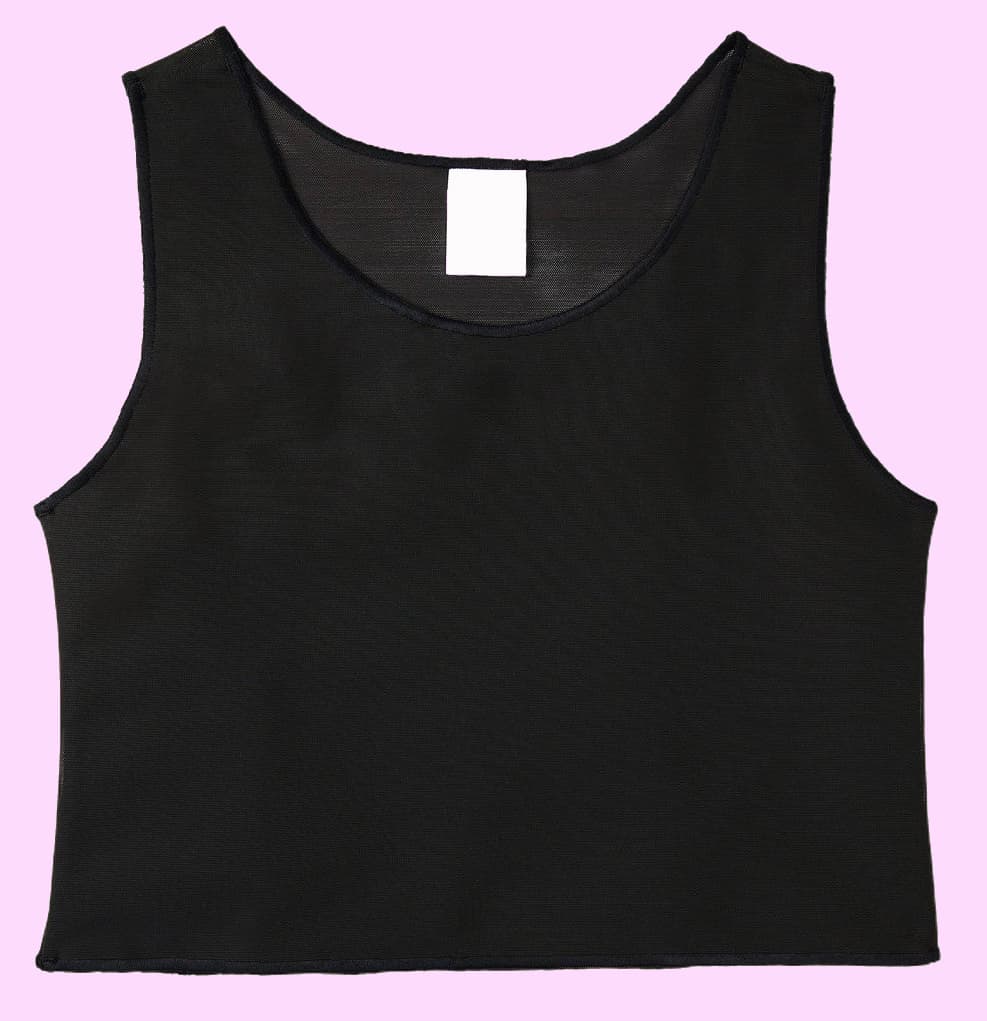
Compression Shirt 1 looks just like the one I used to wear. Double paned on the front side, single on the back. They make half and full sized ones, the full sized ones, for me - would roll up over my hips, squeezing me at the edge of my pants. The half sized ones would push my belly out. All of them making it hard to breathe when in them, and hard to breathe when out of them for different reasons.

Compression Shirt 2 is from Carla Fong’s article “Disclosure: The Twins” from Transgender Tapestry 2001, page 43. In this article Carla speaks about getting breast implants and her experiences with the surgery, the steri-strip bandaids that cover her incisions and the compression zip-front sports bra she wore for eight weeks, 24/7.

Compression Shirt 3 is from the TGSF (Transgender San Francisco) Newsletter, Volume 19, Issue 1. Brooklyn Girl Grows Hair on Chest by Norah Vincent. In this report in the section “The Village Voice” - Norah reports about Drew who will have an ‘ftm’ surgery: a double mastectomy also known as ‘top surgery’. After the surgery Drew will have to wear a compression vest for about three months to make sure that his surgery heals well and his chest re-configures itself. Compression for transformation comes in so many forms.

Compression Shirt 4 is from the Museum of Transology MoT curated by its founder E-J Scott its a UK based collection of objects & community archive - engaging the lives of transgender, non-binary and intesex people. This specific binder is from Katy Davies © Fashion Space Gallery. The tag reads “This is my first binder. I got it when I first came out as trans, very shortly after reading ‘Nina Here [N]or There.’ The first time I wore this, I finally saw myself in the mirror the way I see myself in my head.”

1. This is an underworks compression shirt just like the one I used to wear. Its set on a light pink background. Its double paned on the front and single paned on the back. It looks like a tank-top and is rough though breathable to the touch. When it gets sweaty, best way to get it clean is to soak it in vinegar. 
2. Here is an excerpt from the story “Disclosure: The Twins” from Carla Fong’s article in Transgender Tapestry. The sentence mentioning a compression shirt reads: “My surgeon believes in compression speed healing, so a zip-front sports bra was my constant companion for eight weeks, 24/7.”
3. Here is an excerpt from the story “Brooklyn Girl Grows Hair on Chest” by Norah Vincent about (who I perceive to be) a trans man Drew. The sentence mentioning a compression shirt reads: “For up to three months after the surgery, Drew will have to wear a compression vest that will enable his skin to attach itself to the newly exposed pectoral muscles.” 
4. This is a compression shirt from the archive “Museum of Transology” - this one we know is from Katy Davies. It is also an underworks compression shirt and it has a a brown tag attached to it, like all the objects from this Museum archive project do. On the tag it reads “This is my first binder. I got it when I first came out as trans, very shortly after reading ‘Nina Here or There.” The first time I wore this, I finally saw myself in the mirror the way I see myself in my head.

Weighted Blankets

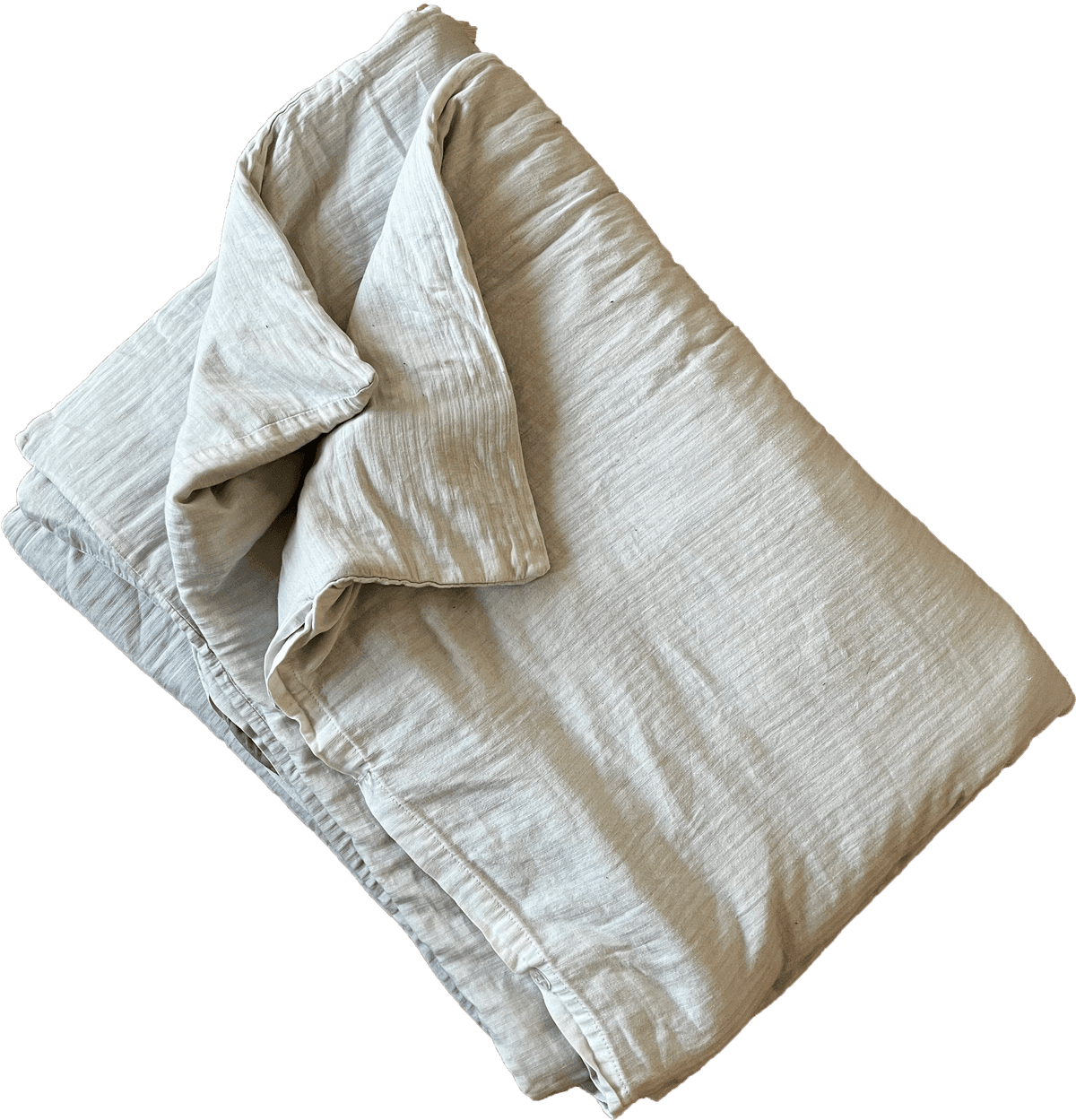
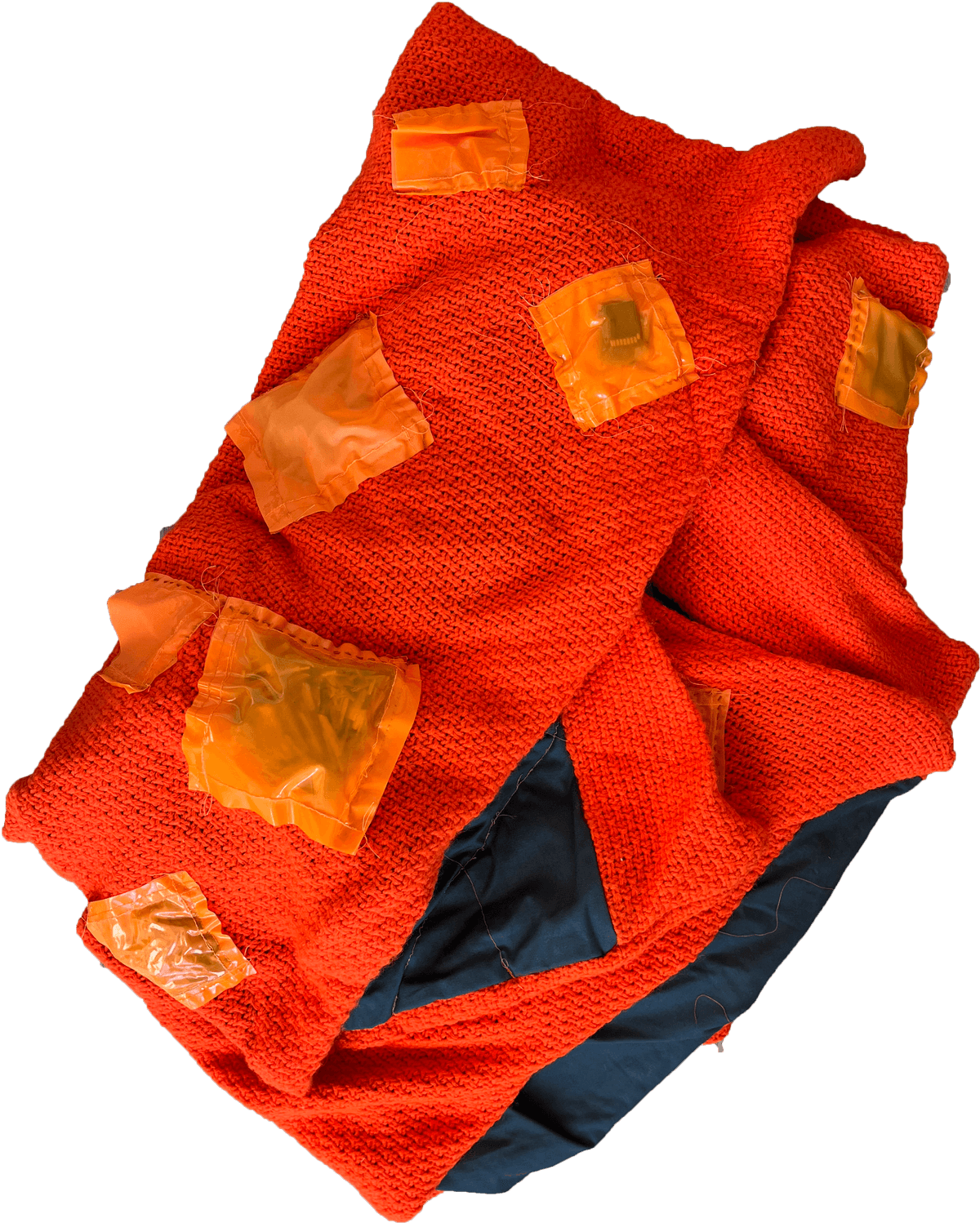
Weighted blankets are a technology for anyone who wants to weigh their body down to calm their nervous system. As a series of small plates of weight laid on top of bodies, the experience of this blanket is like being smushed down with many small weights distributed over the body - a willful pinning down. The first image is of a weighted blanket commercially bought. The second image is a weighted blanket made by Iz Paehr & Ren Loren Britton in their project "A Data Set of Weight".
1. This is a weighted blanket wrapped in a duvet cover. It is folded neatly and presses the body down under about 7 kilos of weight.
2. This is the weighted blanket “A Data Set of Weight” from Ren Loren Britton & Iz Paehr. The blanket is made out of a thick knitted fabric and a thin cotton. Sewn onto the blanket in a series of pockets are various objects that have various weights. Laying under it, you feel the weight of this specific data set.

‘Iron Lung’ in Behinderte Zukunft / Disabled Future: Zur Situation der Körperbehinderten Kinder in der Bundesrepublik Deutschland / The situation of physically disabled children in the Federal Republic of Germany 

Werner Herzog Productions

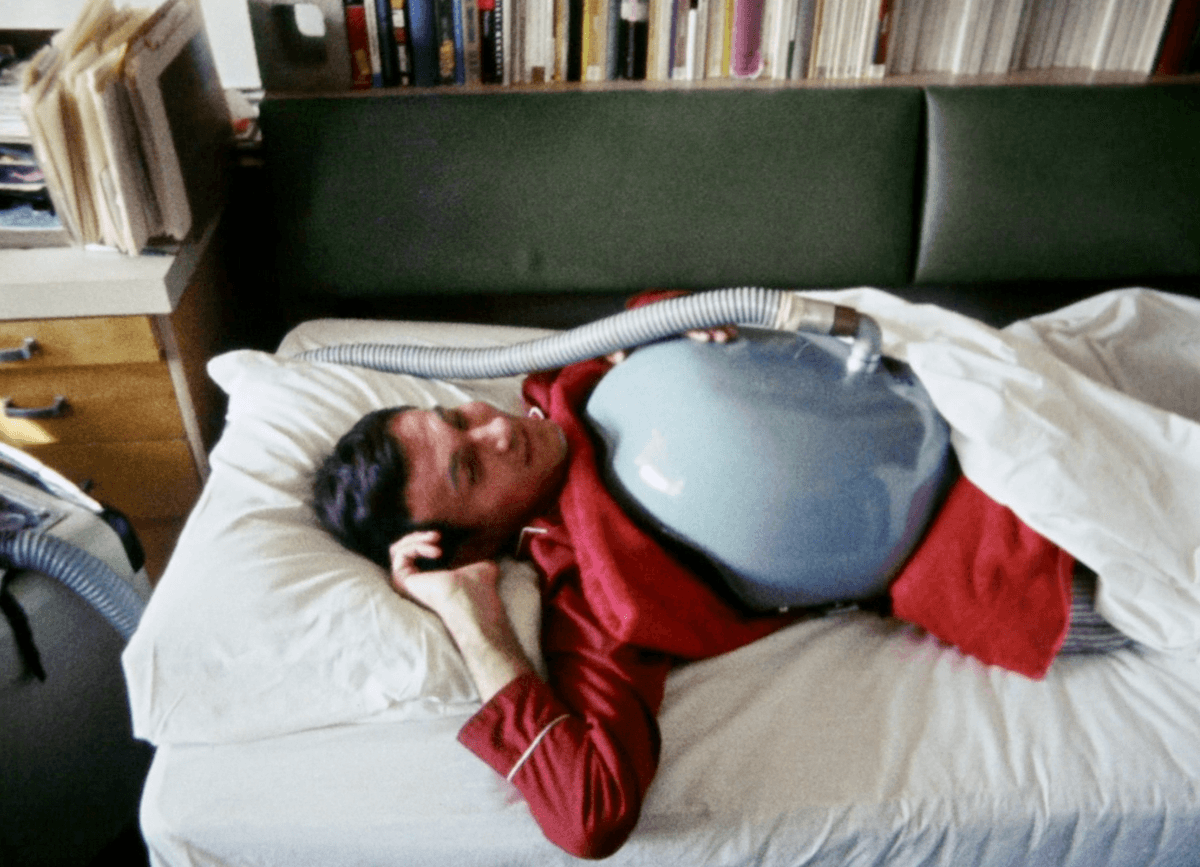
This entry centers the agency of Adolf Ratzka and his web of care relations that enabled him to study at the University of California in Los Angeles. During this experience he came into contact with the Independent Living movement a movement in California - the ethos around which promotes and enables “the same range of options and same degree of self-determination that people without a disability take for granted.” Due to the assistance that Ratzka had from the German state he paid hired, trained and managed his own assistants enabling him to live independently in an dormitory during his studies. In this still from the film Behinderte Zukunft we see Ratzka in bed in a semi-portable iron lung that enabled him to sleep safely and well. A compression of the lungs in needed rhythm.

Werner Herzog, Hans-Peter Meier: Director, Producer

Rolf Illig: Narrator

Jörg Schimidt-Reitwein: Cinematographer

Beate Mainka-Jellinghaus: Editor

1. In this image Adolf Ratzka is laying in bed wearing red pajamas. Behind him are many books on a shelf. Over his chest he has a large blue iron half dome that has a tube connected to it. He rests on the pillow with a half smile on his face.